We prioritize cars so often that it is not always clear where design choices are being made. When design choices are seen as the default state, rather than intentional decisions, it is difficult to consider alternatives or demand change. In this article, I highlight four infrastructural decisions we tend to take for granted by imagining what might be possible without the ideological assumption of car dominance.
Sidewalk
Intersections
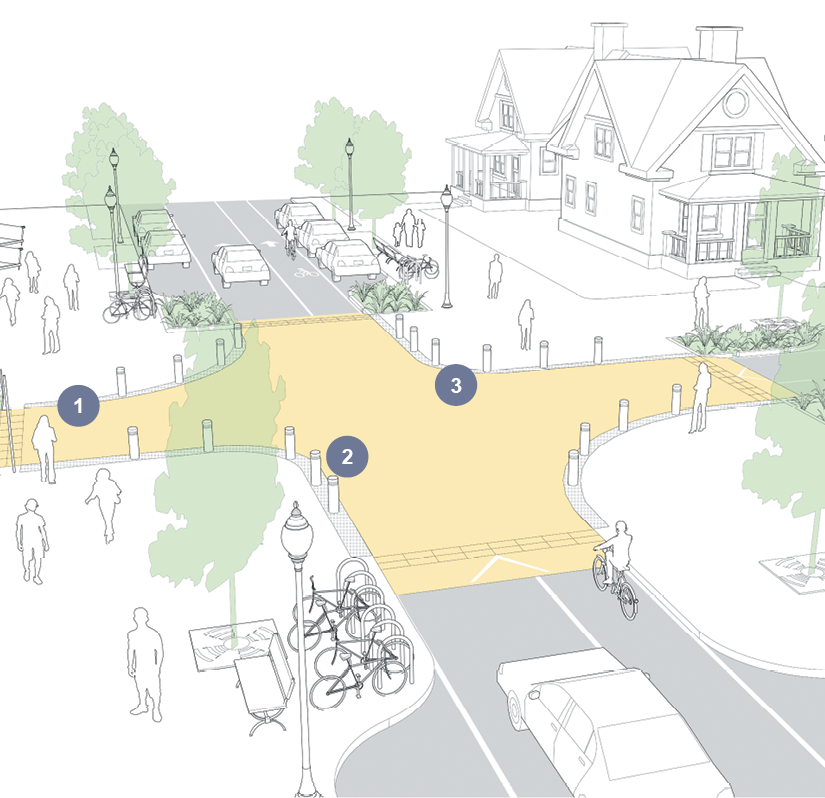
An intersection is the space where roads cross. But on city streets, pedestrian paths also must cross here, causing us to make a design choice. And at every intersection, we’ve chosen to prioritize cars by ending the sidewalk and making pedestrians cross over the road. What if, instead, cars had to cross over the sidewalk?
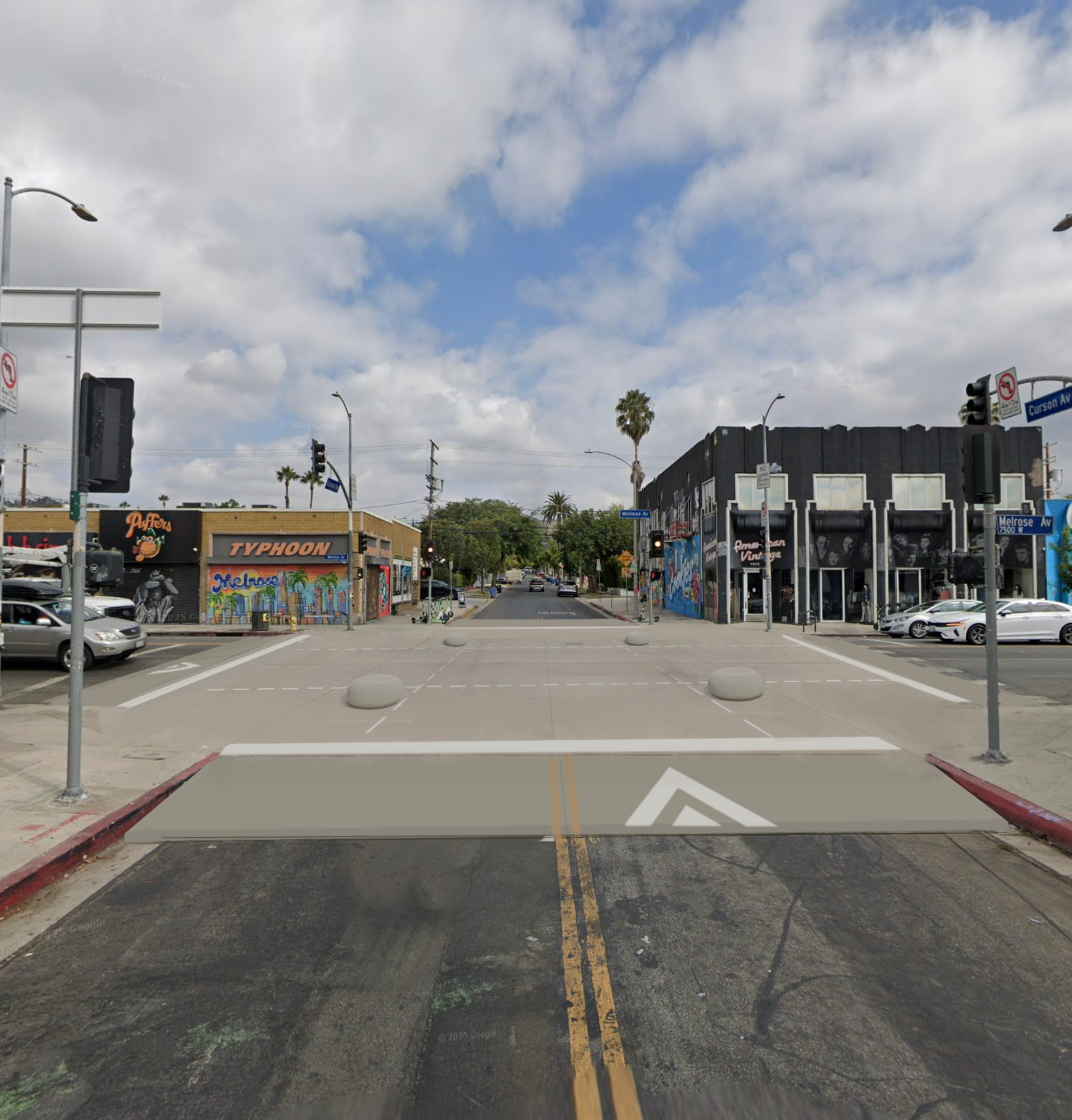
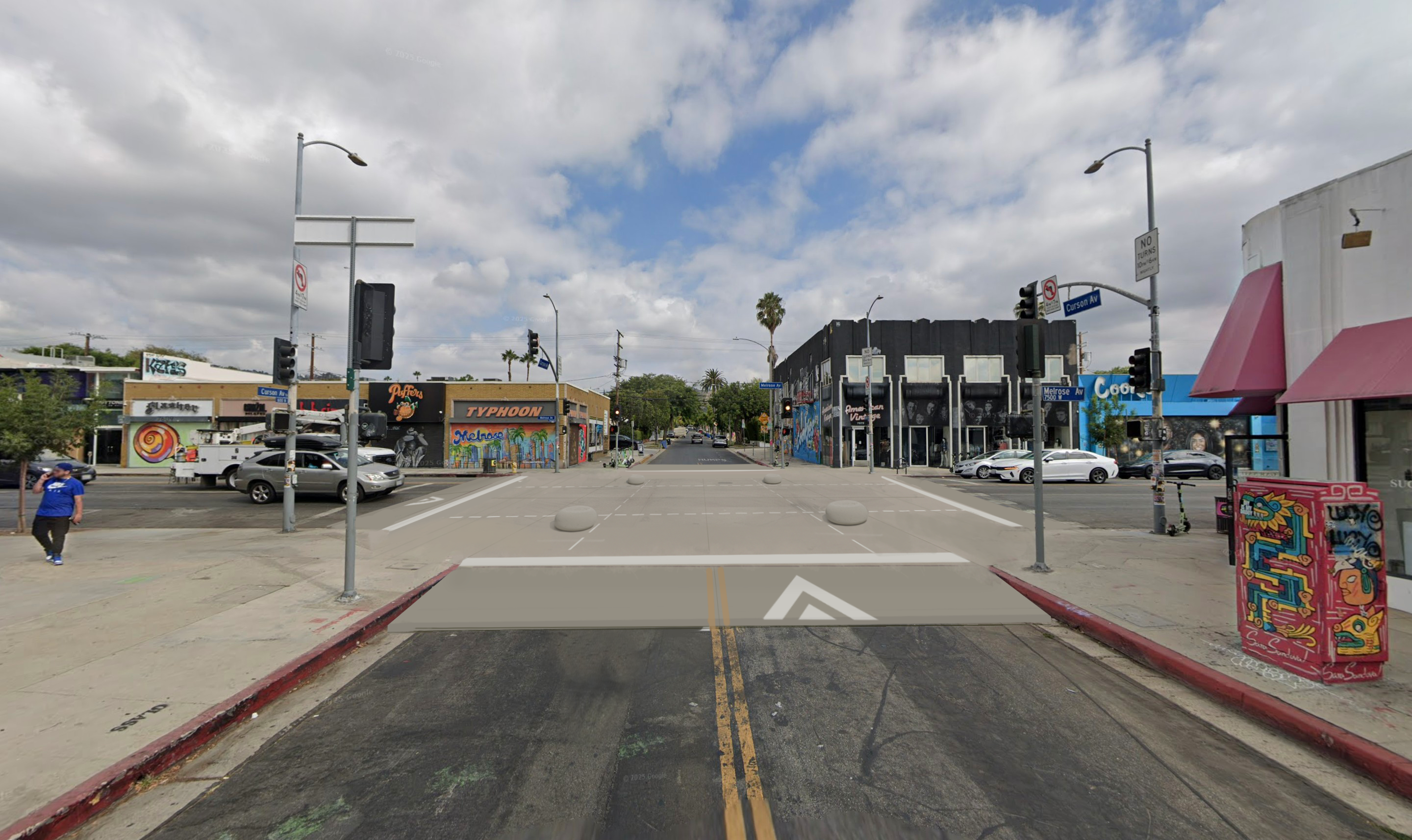
In this way, instead of a walk signal briefly allowing pedestrians into the roadway, a green light would allow cars onto the sidewalk, crossing at a designated area. Even though there are the same conflict points, the power in this difference is conceptual; pedestrians are no longer the ones intruding on the space laid out for cars; cars become the guests. Instead of pedestrians stepping down into the road, cars must navigate around pedestrians at their level.
In urban planning, this transformation is called a “raised intersection”1 and has been shown to significantly decrease accidents2 and enhance pedestrian accessibility, especially for people will mobility challenges3. There are already some being implemented in America, such as in Bellevue, WA4, although road intersections continue to be the default.
Designated Parking Only
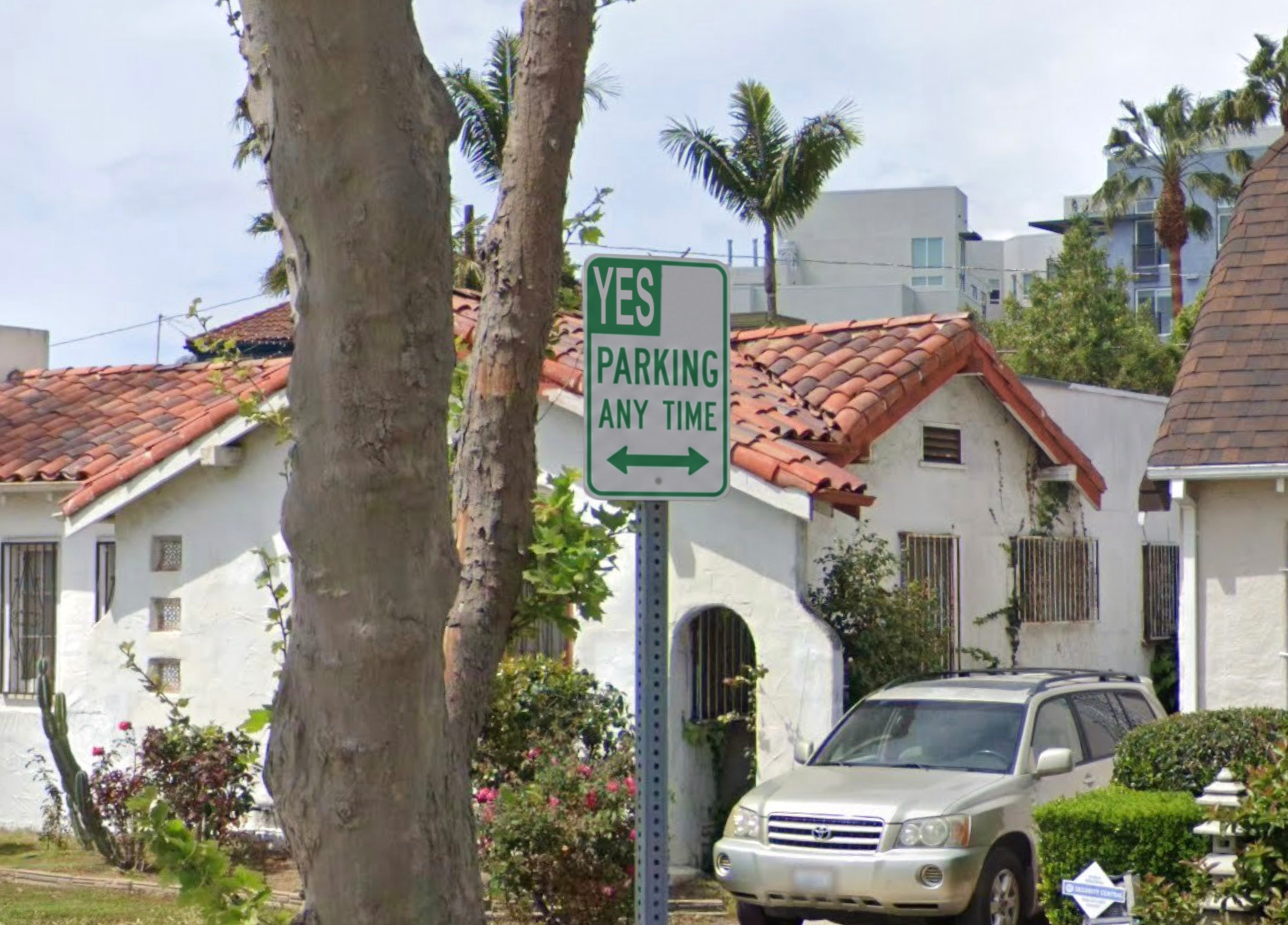
The reason you have never seen a “Yes Parking Any Time” sign is because it would be redundant. “Yes Parking Any Time” is already the unstated rule for every unpainted curb on every street in America; all signage thus carves out the area where and when you can’t park, rather than where and when you can. This paradigm represents a monumental infrastructural giveaway from city governments towards the free storage of cars. Further, the ability to store your car at your destination has now become a default expectation. But what if this wasn’t the case? What if, instead, “no parking any time” was the default? What if areas for car parking had to be explicitly designated as such?
Imagine if, magically, this switch were to happen overnight, and all red curbs disappeared and all unpainted curbs became suddenly painted green, signalling that parking was permitted. Even without changing the number of parking spaces, planners would then have to make more intentional decisions about where specifically they would like to add parking, and additionally, how much to charge for it. Importantly, this additive process unveils the fact that parking spaces are physical amenities with significant value. Instead, our unmarked curbs conceal these tremendous citywide car infrastructure subsidies as default space.
All Red Lights Without Cars
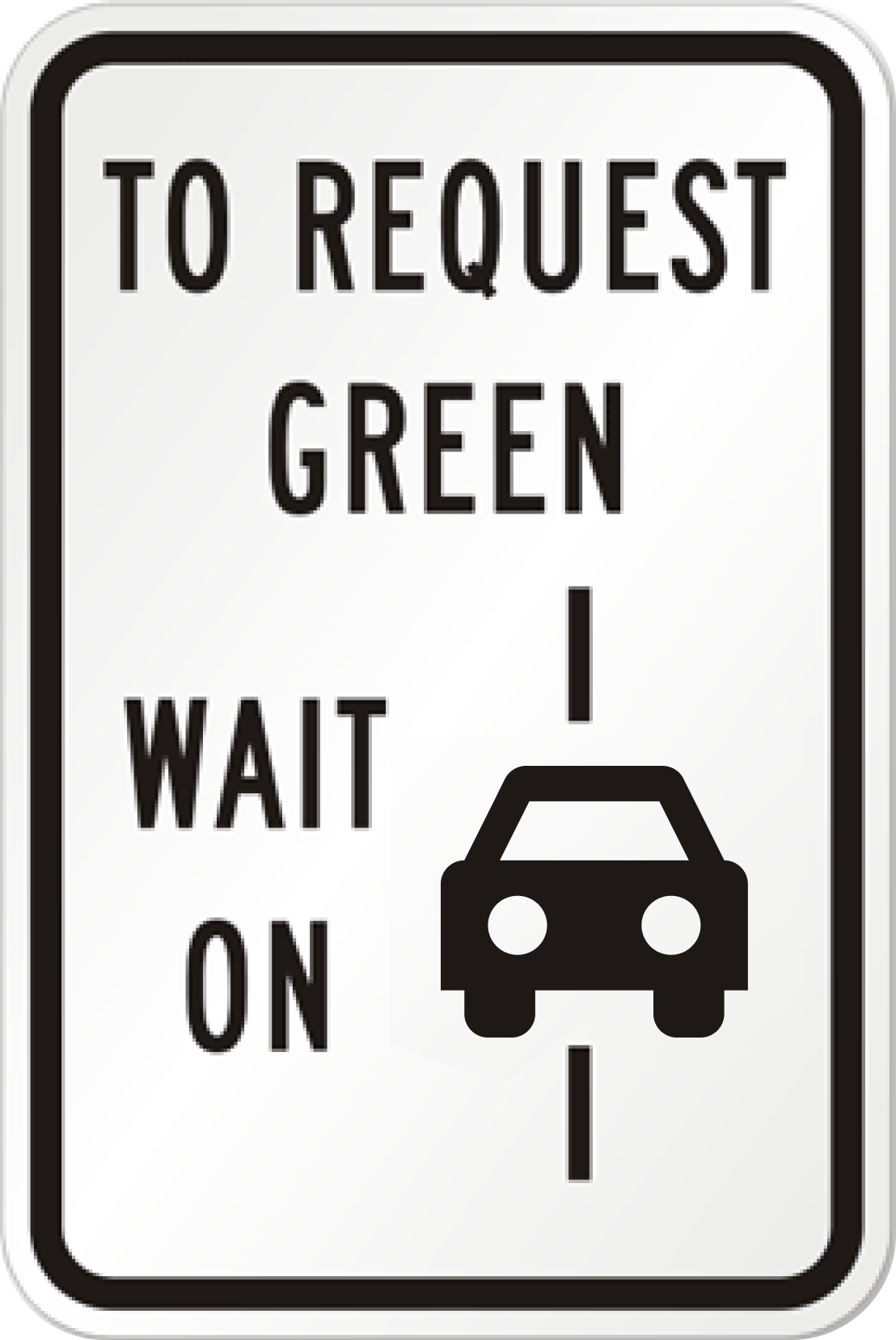
The basic mechanism behind a traffic signal is a switch, allowing one direction of traffic to go while stopping the other. In other words, perpindicular directions are never both green nor are they both be red, other than during the transition. Meanwhile, pedestrians must press a button once they arrive at an intersection and wait for a signal that permits them to walk. What if this wasn’t the case? What if walkable in all directions was the default state of an intersection, and it was cars that had to line up and wait? What if, at night for example, traffic lights stayed red until a car showed up? Only at that point would the pedestrian timer begin to count down, eventually allowing cars to cross.
I first saw this idea when reading an article about accessibility in a 30-minute city5. The author calculates that waiting for pedestrian walk signals amounts to 27% of all walking time in Sydney, effectively shrinking the radius of what is accessible on foot by almost half. Even a less radical version of this idea—allowing pedestrians to cross as soon as they press the walk button, rather than having them wait for an entire green light cycle—would dramatically improve pedestrian accessibility. Quoting the article:
The simplicity of traffic signals—literally summed up to “red light, green light”—conceals the underlying complexity of multimodal navigation through urban space as we choose to optimize the city for cars by default.
Automatic
Speed Limiting
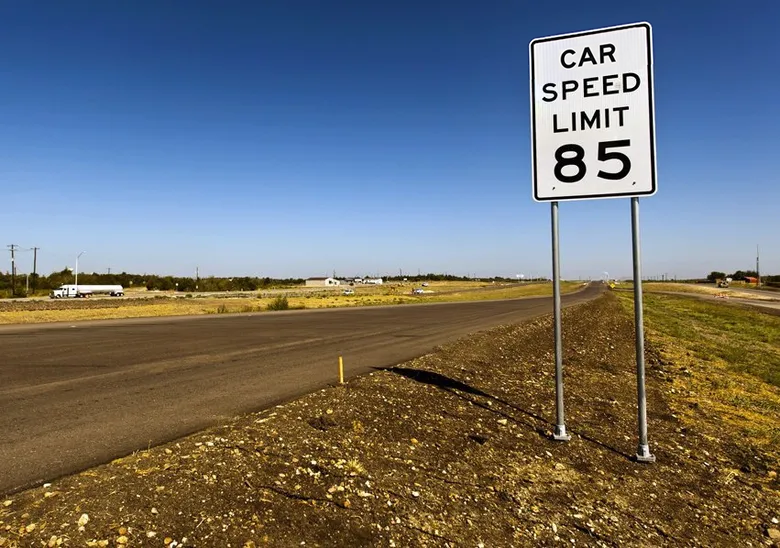
The highest posted speed limit in America is 85mph, on the Texas Highway 1307. In Los Angeles, the fastest you can drive legally is 65mph8, although “10 over the speed limit” is common. Yet I have never driven a car that couldn’t go over 100mph on any road I wanted, and the speedometer in my last car went up to 160mph.
As the speed of a car is the primary factor between a collision resulting in life or death, why do we allow complete freedom of speed? What if, instead, car speeds were automatically capped to 10 over the legal limit? Cars are roughly 10,000x more deadly than e-scooters10, yet within a couple years we have already created location-based automatic speed limiting for scooters11. Thinking outside a world where cars are granted absolute freedoms, it seems totally reasonable to limit speeds around the posted speed limit. In theory, the only people that would even notice such a change are those trying to break the law.
In 2019, the European Union passed some version of this policy, called “Intelligent Speed Assistance”12. In America, this policy was proposed in 2024 by California Senator Scott Wiener and actually passed in the Senate before being vetoed by Gavin Newsom13. For some reason, California politics has now shifted its attention to regulating the speeds of e-bikes14, which are less deadly than cars by many orders of magnitude. Thus, while e-scooters and e-bikes face regulations, unlimited speed continues to be the default for cars in America. Perhaps dreaming of such speed is what helps Americans endure such staggering traffic.
Conclusion
As an LA driver, each of these suggestions would be horrendously inconvenient to me. I like driving, I get overly frustrated by red lights, and I all but refuse to pay for parking. But such is the cost of living in a dense, vibrant city. Over time, it has only ever become more clear that car travel and car speeds need to be de-prioritized in order to create safe, pleasant, unpolluted, colorful urban environments. We can find somewhere else to enjoy driving; city streets are for human activity.
Sources
https://nacto.org/publication/urban-street-design-guide/intersections/raised-intersections/
https://www.tu.no/artikler/opphoyd-kryss-virker-i-danmark-trolig-ogsa-i-norge/510690
https://www.nycstreetdesign.info/geometry/raised-intersection
https://transfersmagazine.org/magazine-article/issue-5/the-30-minute-city/
Ibid.
https://www.seattletimes.com/nation-world/texas-takes-it-to-the-limit-85-mph/
https://dot.ca.gov/programs/safety-programs/setting-speed-limits
There is no real way to calculate the country-wide “at-fault” fatalities of e-scooters, but based on the scarce news articles I am assuming single digits, compared to roughly 40,000 annual car deaths.
https://www.bird.co/blog/bird-community-safety-zones-offer-added-pedestrian-protection/
https://etsc.eu/etsc-welcomes-provisional-deal-on-new-vehicle-safety-standards/
https://calmatters.digitaldemocracy.org/bills/ca_202320240sb961
https://calmatters.digitaldemocracy.org/bills/ca_202520260ab2346