In the last century, so much of our street space has been allocated for car use that it’s difficult to imagine their use for anything else. But this won’t always be the case. As cities turn toward a future without car dependency, streets will need to be radically reconfigured. The first step, then, is to try and reimagine our streets without the cars and asphalt which render them dangerous and dull.
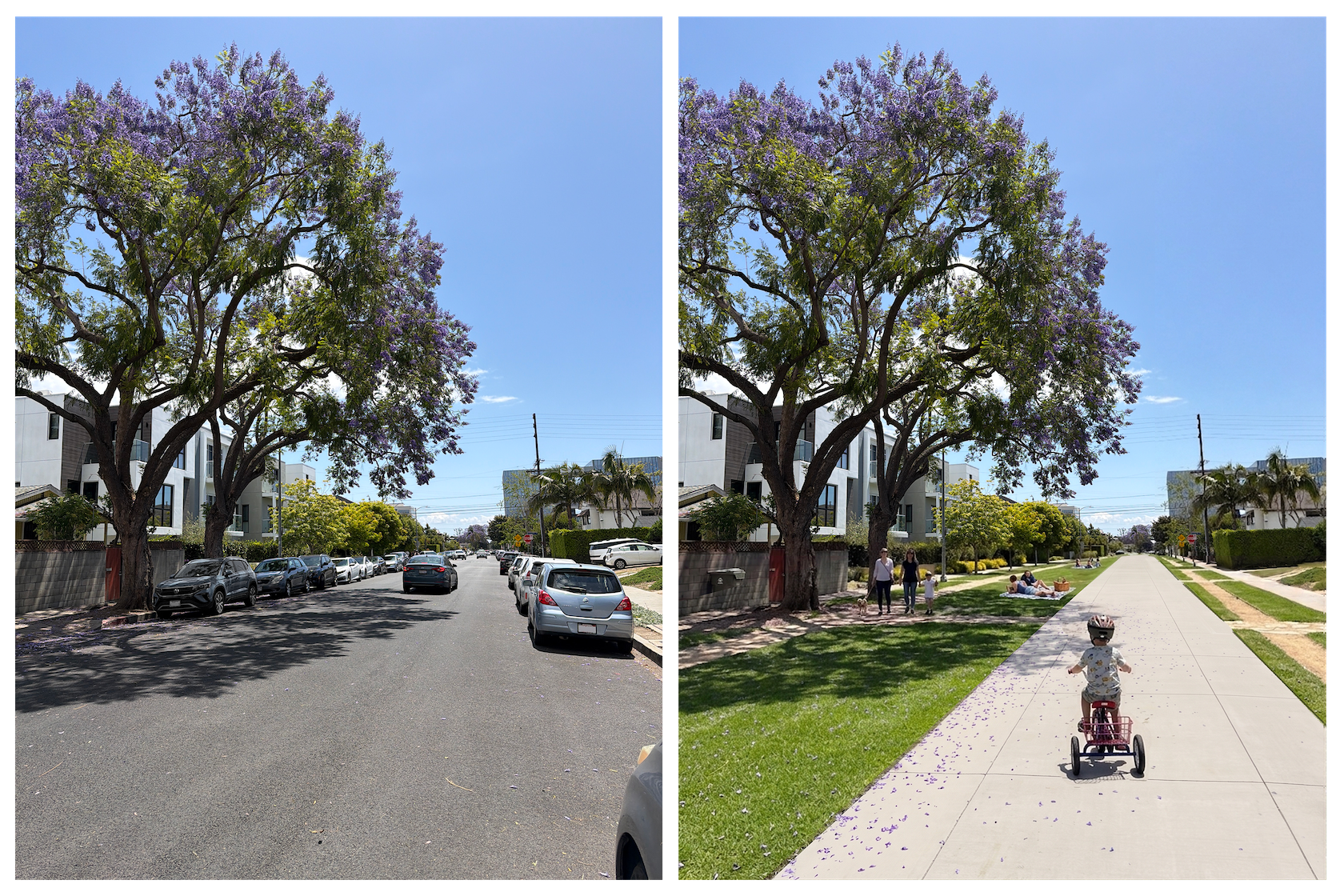
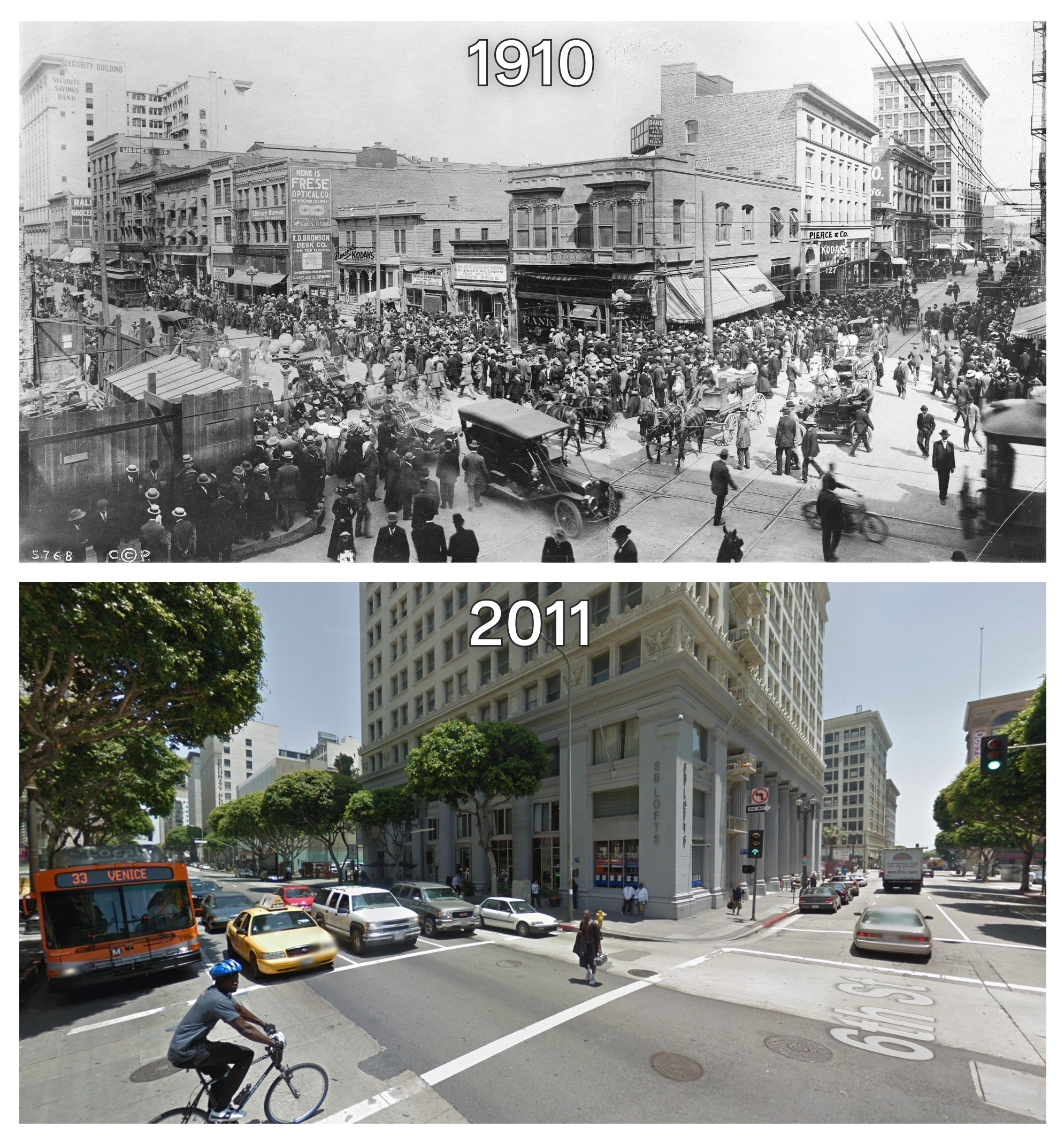
To see beyond the present, it’s helpful to revisit the history of streets. In the thousands of years before cars, streets had a multitude of uses other than transportation1. They were central places for neighborhood social activity and commerce, as well as the main place where children would play. When viewing historical photos of Downtown LA, we can see streets overflowing with commotion. A century later, these very streets function as separators of human activity.
Still, streets are the most basic public spaces of neighborhoods. They form the areas between houses that allow neighbors to connect with one another and move about. However, when streets are designated primarily for car use, residents become more isolated2, walkability decreases3,4, and neighborhoods become more dangerous5. This is especially a problem for children, who have increasingly become reliant on their parents for social activity6,7, as well as aging populations that might not want to or be able to drive8. In American cities these consequences have become completely normalized.
→ But where will I park my car?
Today, there are tremendous structural barriers to post-car street transformations. Such barriers include the need for a monumental investment into public transportation, as well as a massive cultural shift away from private car ownership. Such a future will require the widespread adoption of active forms of transportation like walking and biking. Fortunately, it seems like this cultural shift has already begun. Car ownership rates are decreasing among younger generations in the U.S.9,10, and Americans increasingly value walkability. A recent survey found that 78% percent of Americans said they would pay more to live in a walkable area11. Additionally, the cost of car ownership is at an all time high12, and gas prices continue to soar 13.
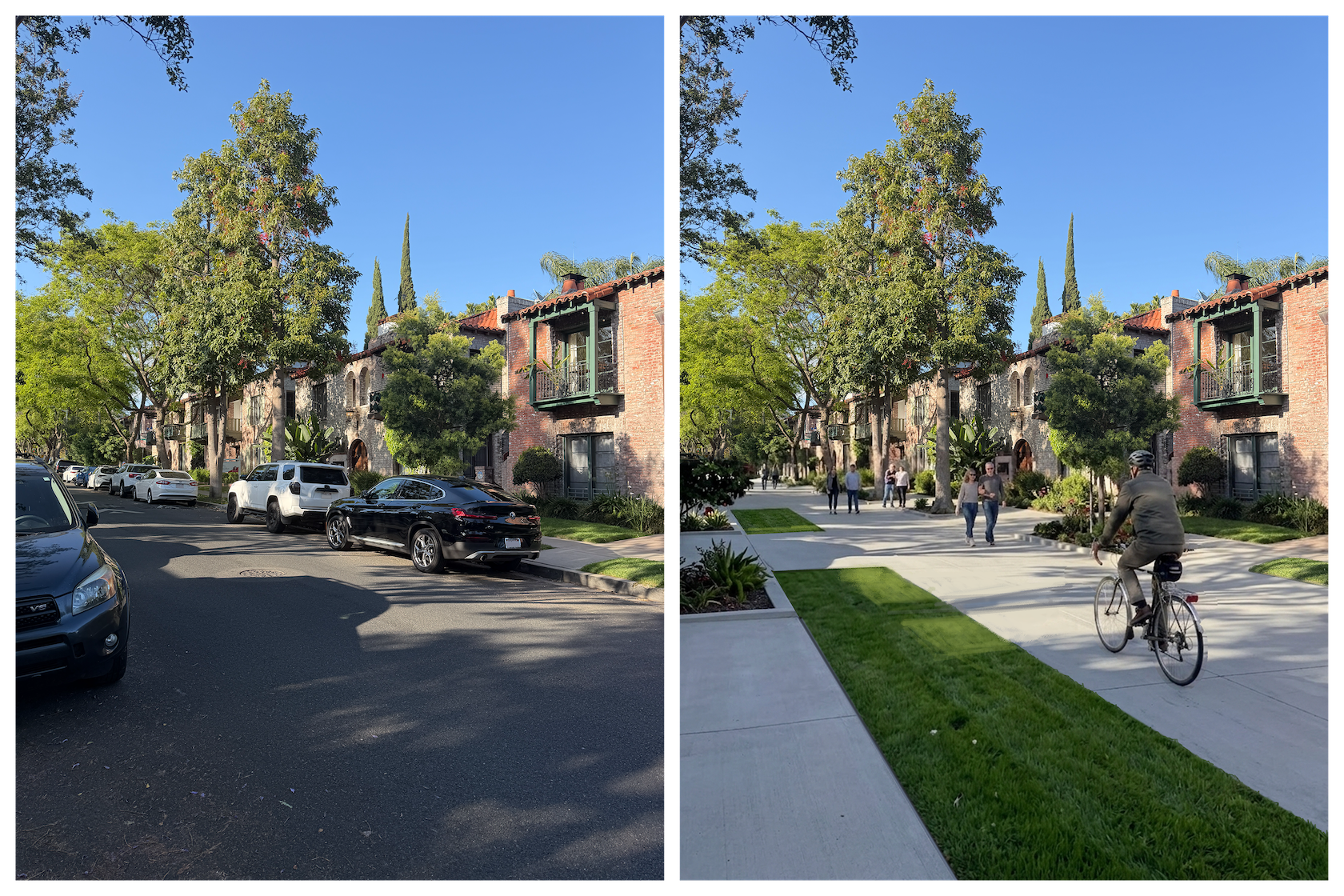
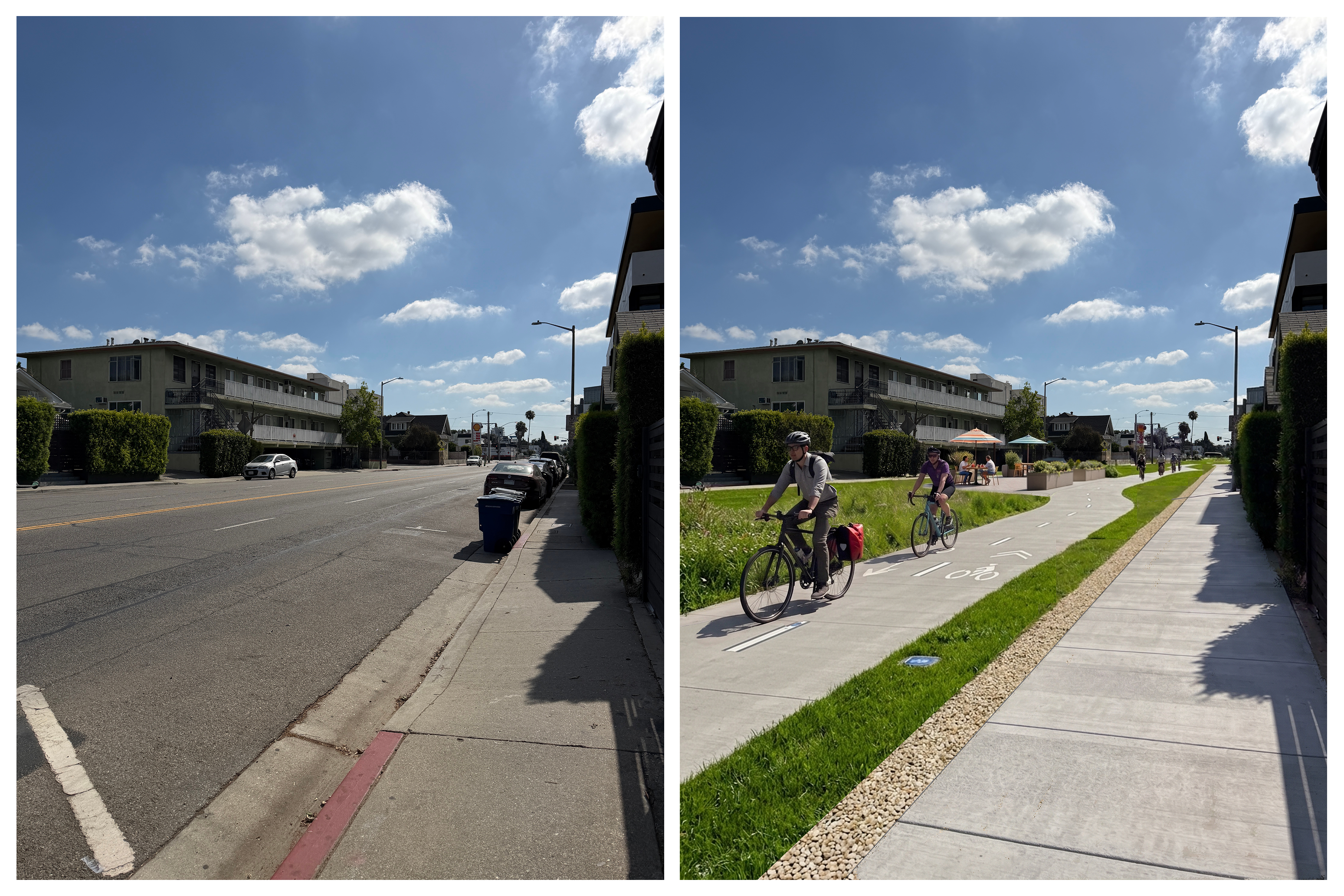
However, the point of these images is to allow us to wonder: how much of a distaste for walking is actually because of cars? Would you be more willing to walk further through the streets on the right?
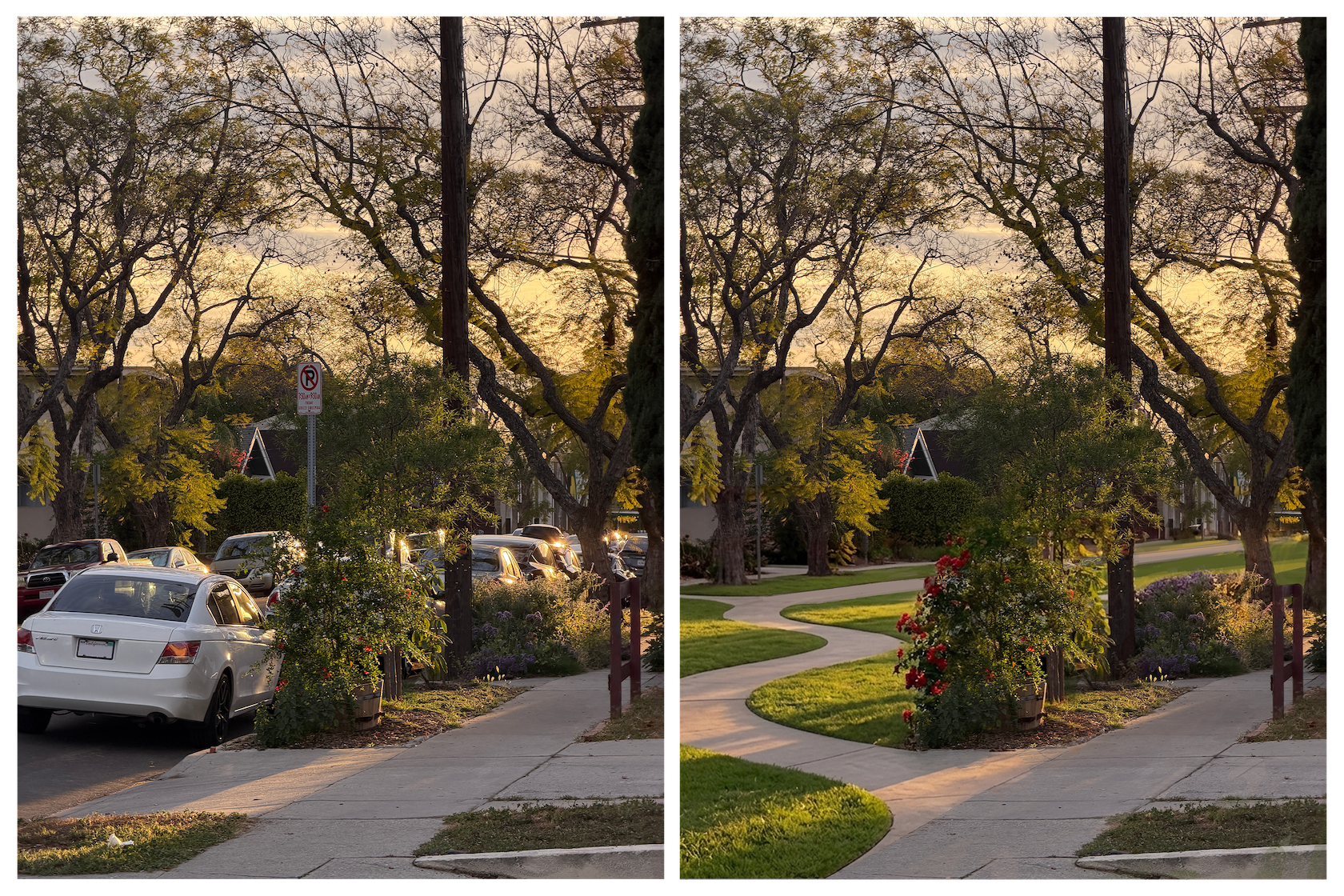
At this time, the right-hand images might seem incredibly far-fetched, especially for Los Angeles, of all places. Indeed—such changes will require a herculean effort against the status quo. But here is the good news: radical changes are already happening in cities across the globe, and time and time again, they continue to be wildly popular after they are completed14,15. Despite initial public outcry, once cars are removed, people generally don’t want them back16.
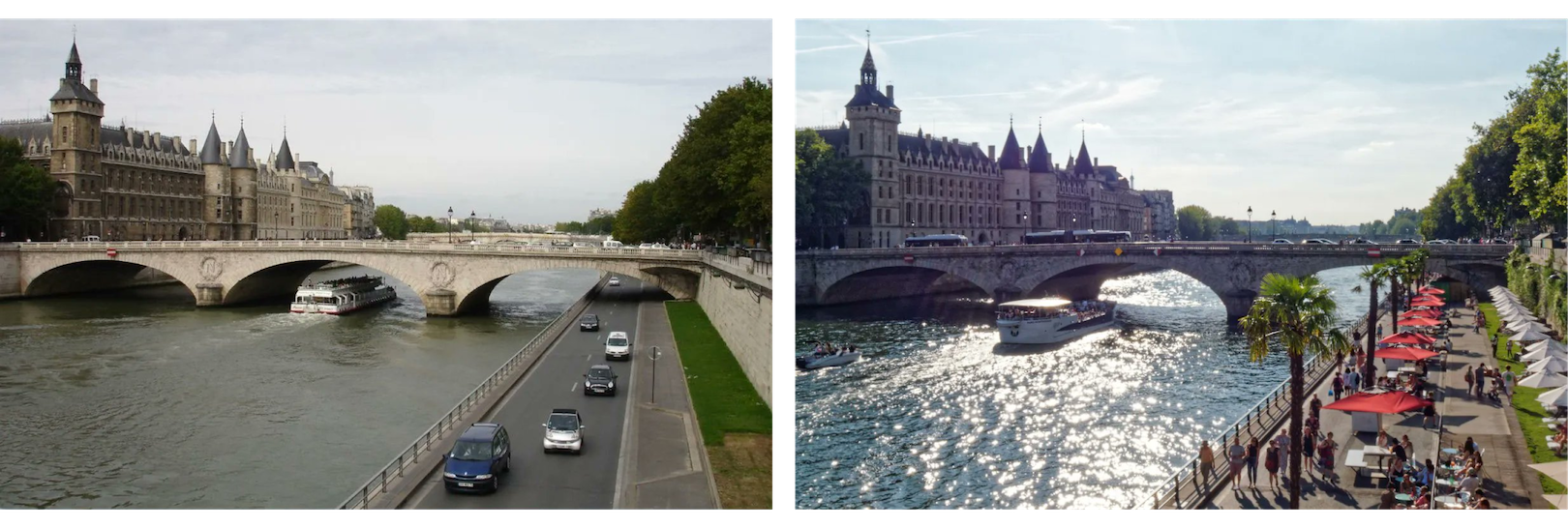
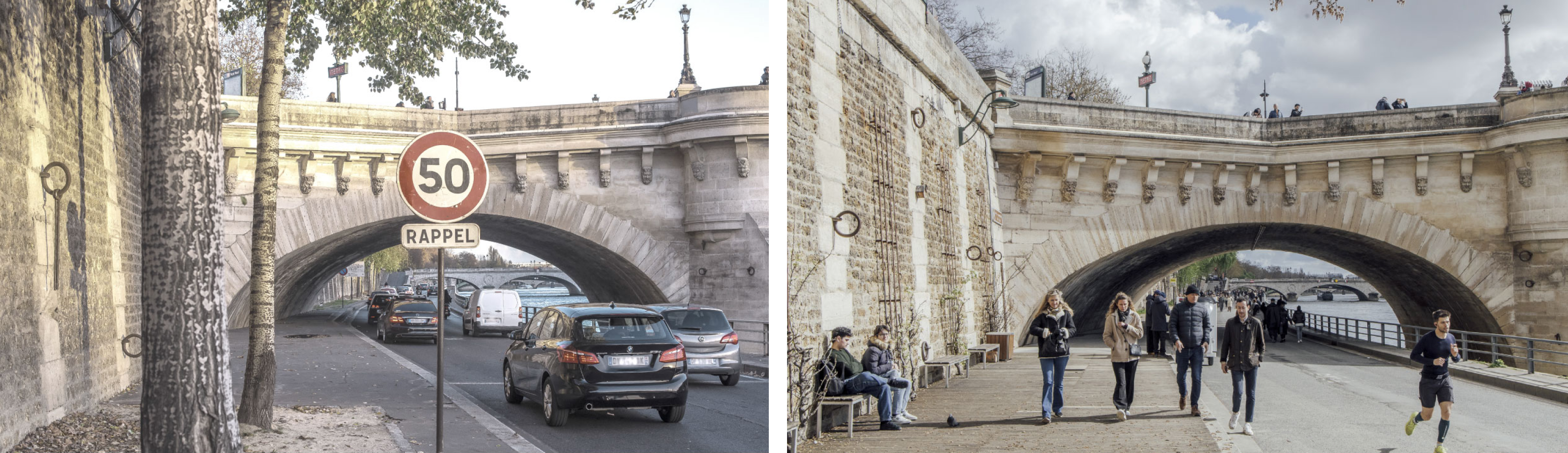
After a century of experimenting with adding cars into cities, the fight against urban car dependency will now become a defining part of the legacy of our generation. Long after the dust settles and the last parking meters have been turned to scrap, future generations will look at these comparison pictures and find the left images to be ridiculous, asking “Where the hell did you even walk?”
Sources
Norton, Peter D. Fighting Traffic: The Dawn of the Motor Age in the American City. The MIT Press, 2008. http://www.jstor.org/stable/j.ctt5hhckp.
Qin, Weidi et al. “Driving Cessation and Social Isolation in Older Adults.” Journal of aging and health vol. 32,9 (2020): 962-971. doi:10.1177/0898264319870400
Jin L, Lu W and Sun P (2022) Preference for Street Environment Based on Route Choice Behavior While Walking. Front. Public Health 10:880251. doi: 10.3389/fpubh.2022.880251
LaJeunesse, S., Ryus, P., Kumfer, W., Kothuri, S., & Nordback, K. (2021). Measuring Pedestrian Level of Stress in Urban Environments: Naturalistic Walking Pilot Study. Transportation Research Record: Journal of the Transportation Research Board, 2675(10), 109-119.
Yijia Hu, Long Chen, Zhan Zhao. “How does street environment affect pedestrian crash risks? A link-level analysis using street view image-based pedestrian exposure measurement” Accident Analysis & Prevention Volume 205, 2024, 107682, ISSN 0001-4575, https://doi.org/10.1016/j.aap.2024.107682.
https://www.theatlantic.com/family/archive/2024/07/play-streets-children-adults/679258/
Mcdonald, N. “Active Transportation to SchoolTrends Among U.S. Schoolchildren, 1969–2001.” American Journal of Preventive Medicine, vol. 32, no. 6, June 2007, pp. 509–16. DOI.org (Crossref), https://doi.org/10.1016/j.amepre.2007.02.022.
Qin, Weidi et al. “Driving Cessation and Social Isolation in Older Adults.” Journal of aging and health vol. 32,9 (2020): 962-971. doi:10.1177/0898264319870400
Zhong, Laitian and Bumsoo Lee. 2017. Carless or car later? Declining car ownership of Millennial households in the Puget Sound Region, Washington State. Transportation Research Record: Journal of the Transportation Research Board 2664: 69-78. doi: 10.3141/2664-08.
https://www.statista.com/chart/33097/importance-of-owning-a-car-for-us-residents-by-generation/
https://www.nar.realtor/reports/nar-community-and-transportation-preferences-surveys
https://abcnews.com/Business/us-gasoline-prices-hit-highest-level-4-years/story?id=132459162
Nello-Deakin, Samuel, et al. “Who’s Afraid of Pedestrianisation? Residents’ Perceptions and Preferences on Street Transformation.” Habitat International, vol. 150, Aug. 2024, p. 103117. DOI.org (Crossref), https://doi.org/10.1016/j.habitatint.2024.103117.
https://www.dw.com/en/a-pedestrian-zone-to-be-created-along-the-seine-in-paris/a-19529467
Natterer, E. S., Loder, A., & Bogenberger, K. (2026). Effects of Paris’ Cycling Policies on Vehicular Flow: An Empirical Analysis. Transportation Research Record: Journal of the Transportation Research Board, 2680(1), 138-152.